


With phones and screens literally everywhere, and 24/7 access to the internet, endless videos, games and goodness knows what else… it’s no wonder we’re trying to step away from it – or at least, make sure our children do.
It’s a question I think about a lot now I have my 18 month old son.
The last lucky generation
Millennials were the last lucky generation to have grown up not constantly contactable, able to enjoy life without being glued to a screen. Unless, of course, it was to write out a tenpence 160-character text on our flip phones, play snake on our Nokia bricks, or Sims on our shared family computers. We grew up listening to the beeps and static tones of dial up. We had televisions which only played VHS cassette tapes and live TV: so no constant stream of flashy adverts and no sea of endless streaming content to drown in. It was a simpler time.
From a child’s perspective – they see us adults like zombies, gazing constantly at our thin slice of metal. What is so intriguing? Of course, when you’re actually on your phone you could be doing a number of things: shopping, reply to messages, checking social media, reading the news or booking an event or activity. Problem is, children don’t see that. Phones look way more important and attention grabbing.
We know how harmful and addictive screens and social media can be.
According to The Guardian, only 3% of eleven year olds don’t own a smartphone in February 2024, and on average a teenager is on their phone for five hours a day, with TikTok and Snapchat being the main apps spent time on.
Mental health decline
Gen Z and beyond have been essentially, unconsciously, participating in an ongoing experiment to see how screen technology affects us. Now in 2025, we’ve started to see the research come in about mental health decline as a result of extensive social media use.
Studies show a strong link between the amount of time spent on social media and mental health problems.
- Adolescents who spend more than three hours per day on social media face double the risk of experiencing poor mental health outcomes, including symptoms of depression and anxiety.
- One meta-analysis found that for each hour increase in social media use among adolescents, there was a 13% increased risk of depression.
- Research from the WHO Regional Office for Europe in 2024 revealed that over 1 in 10 adolescents show signs of problematic social media use, which is linked to less sleep and later bedtimes.
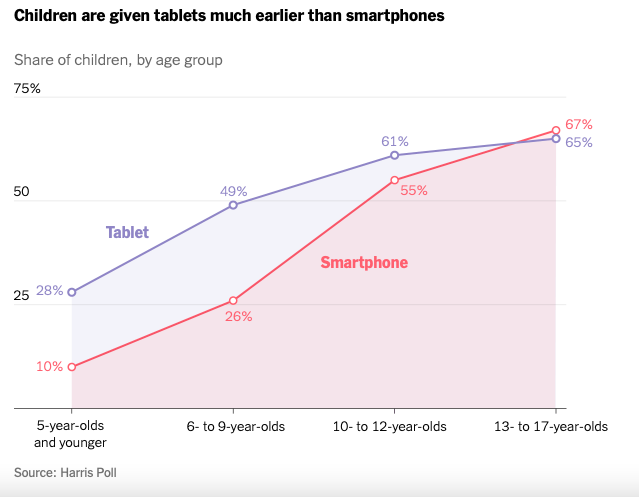
With more untested technologies like AI now filtering into every corner of the academic learning, it’s never been more important to restrict early access.
What’s being done to protect children?
Globally, there has been some progress. Australia has recently raised the age to open social media accounts to 16, with France set to enact a similar restriction of 15 years old if the EU doesn’t enforce first. Every school in Brazil is phone-free from the start of the school day to the end. Some schools in the UK are going phone-free too with complete bans.
In February 2024, the UK government also issued guidance for schools to prohibit the use of phones throughout the school day.

Moving forward as millennial parents
It is really hard, we all know that “free” time is previous, and anything that can help us get the day done, is a godsend. Sometimes a strategic episode of Teletubbies to get the dishes done is necessary. However, how do we try and raise children who aren’t completely and utterly dependent on screens?
Set Clear Boundaries: Implement rules for screen access, such as not allowing phones at the dinner table, in bedrooms, or during family time. One thing we’ll be doing is having a “family” mobile – akin to the landline phone in days of old. This will stay in the kitchen but anyone can use to message or call friends.
Model Healthy Habits: Be mindful of your own screen use, as children learn by observing their parents.
Prioritise Offline Activities: Encourage imaginative play, outdoor exploration, reading, and other activities that build different skills and offer alternatives to screens.
Foster Emotional Regulation: Teach children how to manage their emotions and find calm without relying on a device, and seek professional help if they seem dependent on their phones.
Create a Supportive Environment: Build communities and support networks with other families to share strategies and resources for navigating the digital world. The more people who are doing the same as you, the easier it’ll feel!
Embrace the Digital Age: Instead of viewing screens as inherently bad, focus on teaching children how to be active and purposeful users of technology, rather than passive consumers.
It’ll be interesting to see where the realms of social media use and screen useage ends up over the next few years.
For now, we can only try our best to work with the knowledge we have, and try to implement healthy behaviours.
What are your thoughts on screen use for children?