

It’s World Mental Health Day, and it’s never been more important to talk about it.
I’ve been writing about mental health for years on this blog, and it’s been a central pillar of my content, whether it be in relation to dating and heartbreak, relationships or modern general life. One of my first posts back in 2015, My Own Experience of Panic Attacks, was about how I experienced panic disorder and how it affected my daily life. Then in 2017, I wrote about World Mental Health day and how it’s a taboo subject and something that can hide in plain sight.
Nearly 10 years on, suicide is still the leading cause of death in 20-34 year olds*. With 24 hour news at our finger tips and our phones glued to hands, it’s no wonder that the constant presence of social media has made its mark on our brains, and not in a good way.
Personally, my own mental health has shifted and metamorphosed away from being mainly anxiety and panic based, to being more postpartum centric. Whilst anxiety and panic no longer plays a role in my life, it’s interesting to see how my mental health has changed.
Postpartum depression
Come 2026 and I’ve been through some of the most challenging months in recent years for my mental health. As I said back in 2017, I write openly about my mental health, but it’s something I rarely talk about out loud. When I do, I feel exceptionally vulnerable.
Having given birth to two boys in the last two years, I’ve experienced postpartum and all that comes with it. It’s been simultaneously the most beautiful, best time of my life, and yet also the darkest and loneliest. When you become a parent, your identity changes in ways you can’t fathom, and along with sleep deprivation, the weight of huge responsibility, and hormonal and body changes, it can be quite the adjustment. And especially hard on your mental health.
Having a child changes your brain, quite literally. With my first, I experienced what I believed to be postpartum anxiety, OCD and depression with regard to my own health. This was a result of my anaemia from birth blood loss, and my breast abscess which I was having to tackle, alongside learning to be a new mum and having a fragile little infant I was responsible for.
Second time around, I had no issues during pregnancy, or with my physical health thankfully. However, sleep deprivation and my hormones hit harder this time and I was struggling a lot with feeling completely unlike myself, whilst caring for a baby and a toddler.
I knew things weren’t right, so I took myself to the doctors early on. Unfortunately, as I explained to the doctor I saw, I’m high functioning and so you wouldn’t know how I was feeling behind my polite smile. Despite this, I was deemed okay and was given a referral link to complete to go to CBT.
Having had counselling for years, as well as going back to college in 2019 to become a counsellor myself, I knew there was only so much the doctor could do, but I did feel like it was a pretty poor response given postpartum mental health should be taken quite seriously.
A taboo and misunderstood subject… still
Many people simply don’t understand mental health, especially if they’re not personally affected. Hearing politicians talk about mental health like it’s been exaggerated is particularly irritating.
Everyone has mental health, whether it be good or bad. It affects all of us in different ways, some more greatly and some less so than others. Unfortunately sometimes if you’re affected badly, it can be misconstrued as weakness or a flaw. That’s simply not the case. Often those with bad mental health are the most resilient people.
How can you help someone who is struggling?
Sometimes it’s really difficult to know what to do when someone confides in you that they’re struggling. You don’t need to know exactly how they’re feeling or have experienced what they’re going through to help either.
Being there for someone and expressing empathy can be as simple as keeping contact and asking how someone is getting on. Knowing someone is looking out for you can be really reassuring. Other ways include:
- Arrange a meet up to keep social contact up
- Offer to help with chores if they’re struggling with keeping ahead with them
- Be there in person to go to appointments together
- Ask how they can be supported best
- Simply listen to them and don’t judge, don’t say “at least…” or “it’s not that bad”, just listen and really hear them
- Educate yourself by looking for info using resources online, like Mind
- The Mental Health Foundation has some great resources to help you become a better listener
No matter what you’re going through, you are not alone, and with support you can get better.
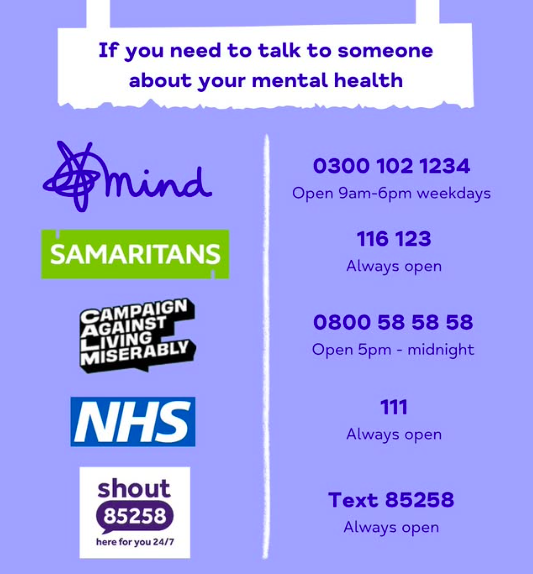
Mind Charity is a great resource and there are plenty of people you can talk to if you need to.
* https://researchbriefings.files.parliament.uk/documents/CBP-7749/CBP-7749.pdf